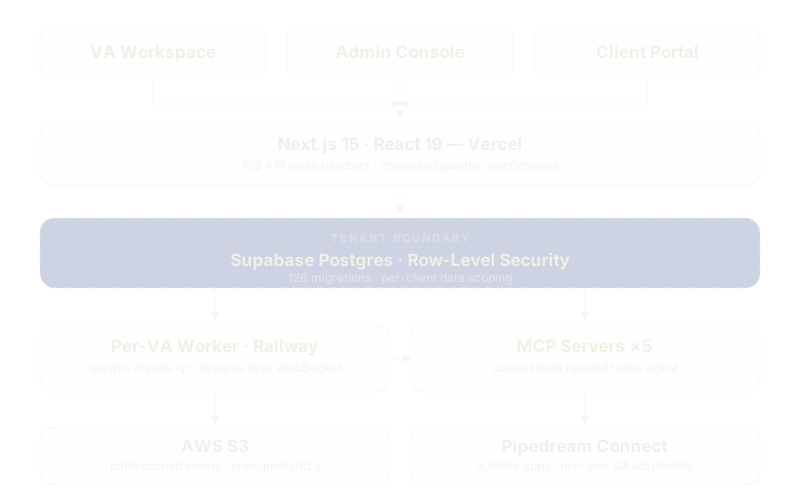
How MAVIS puts Claude Code agents on real client work, with humans holding the approval loop.
A multi-tenant platform where virtual assistants brief Claude Code agents, watch them work, and approve what ships. Agents run on per-VA workers, reach the client's own tools through MCP servers and per-user OAuth, and every client's data is sealed off by Postgres row-level security.
Overview
A virtual-assistant agency wanted its VAs to run client work through Claude Code agents rather than by hand: drafting posts, ads, emails, and reports from the client's own connected tools. Three things make that hard, and none of them are the model. Isolation: an agent session scoped to one client has to be structurally incapable of reading another's data, not merely prompted not to. Tools: an agent is only useful with access to the client's actual Gmail, HubSpot, Slack, and ad accounts, which means per-user OAuth and a tool surface that changes per user. Trust: nothing an agent produces reaches a real client without a human seeing it, so review has to be fast or the humans become the bottleneck and the automation is worthless.
The platform
- Next.js 15 / React 19 dashboard serving three audiences in one app (VA workspace, admin console, and a client-facing portal) across 199 API route handlers
- Per-VA workers on Railway: an Express and WebSocket service that spawns claude -p sessions per job, streams events to the browser, and enforces guardrail timers, loop detection, and per-turn token accounting
- Five MCP servers giving agents path-scoped S3, client-scoped database access, Pipedream Connect, registry-driven proxy operations, and image generation
- Supabase Postgres with 126 migrations and row-level security as the tenant boundary
What I built
- The client portal end to end: task boards, threaded conversations with agents, an asset gallery with in-app PDF, CSV, and audio preview over presigned URLs, and a mobile-responsive pass across every client-facing page
- The task detail and Work Studio surface VAs live in: sticky action bars, slide-in drawers, @mention fan-out in task threads, rich-text composers, screenshot-paste attachment, and status filter chips
- A cmd+k command palette backed by a trigram-indexed search API, and a notifications system with per-user opt-out by type, browser alerts, priority toasts, and deep linking
- The integration layer: threading a Pipedream external-user resolver through every Pipedream-facing path so OAuth grants resolve to the right end user rather than a shared project identity. This is the fix that makes per-client tool access genuinely per-client
- The integrations hub: catalog browsing with pagination, connection state, custom credentials with a live connection probe, and account-health surfacing
- Both LLM feature modules: turning a handful of promoted chat messages into an actionable agenda, and generating task titles, using schema-constrained structured output rather than parsing prose
- The tenant-isolation audit of the client-facing surface, client deactivation with a 90-day data wipe, and the consolidation of ad-hoc per-route auth checks into a shared typed access predicate
Engineering judgment
- Model tier as a decision, not a default. Summarization runs on Haiku 4.5 at roughly $0.001 per call, where a larger model would be overkill, and it fails open: if the call throws, task creation still succeeds with a raw-quote description. Picking the cheap tier and designing the degradation path is the engineering; calling the API is not
- Summaries are additive. The original messages stay in the thread beside the generated agenda, so a VA who distrusts the summary can always read what was actually said. An LLM feature that silently replaces its input is one people learn to switch off
- Auth as a typed predicate rather than a convention. Ten routes each carrying an inline tenant check is ten places to get it wrong. One predicate returning a discriminated union writes the access matrix once and makes the compiler force every caller to handle the failure branch